

When I pressed my palm on the biological scanner for the first time, the 100-meter-high alloy gate behind me slowly closed with a roar like a giant beast swallowing, I knew that I was not entering a prison, but a huge, cold and still breathing metal remains. The corridors here are not built. They are like black blood vessels growing from the inside of the lunar rocks, winding to the dark and unknown organs. The deepest first impression of _Luna Abyss_ is not fear, but an almost sacred sense of oppression — I am not here to serve my sentence, but to do a silent autopsy for the dead soul of a dead satellite.
This huge thing known as “deep prison” is itself the narrator. My task is often to repair a certain ventilation duct or restart an energy node, but every time I climb and grope, my fingertips touch the scars of the past. The walls here are not smooth. They are covered with solidified and splashed metal slag, recording a long-forgotten emergency meltdown. Deep in the ventilation duct, sometimes there is a distant and regular knocking sound. It is not a monster, but an automatic cleaning unit that was permanently sealed in the maintenance channel due to failure a hundred years ago. It is still carrying out its last procedure to clean up the non-existent dust for the residents who have long since disappeared. The building remembers everything. It stubbornly rereads its history with faults, echoes and irreparable structural damage.
The moment that made me most silent happened when I first entered the “Confessor Corridor”. It was a huge circular space, and the surrounding walls were not made of stone, but composed of countless black screens that kept rolling slowly. On the screen, there are not random codes, but broken diary fragments, unsent family book fragments, and the last page of the task report. They came from the early pioneers of the colony, the later administrators, and the prisoners and jailers who were eventually destroyed here. There is no complete story, only a slice of emotions — “Her eyes are like the ocean of the earth, but I can’t remember the blue”, “The pressure valve value is abnormal, but we are ordered to ignore it”, “They say I’m crazy, but the wall is really breathing”. I don’t need to read them. I just need to walk by. When I pass by, those fragments that match my identity band will automatically highlight, whisper, and then extinguish. I’m not checking the archives, I’m walking through a cemetery of consciousness composed of remorse and confusion, and my own sins have become the echo detectors that awaken these spirit.
As the exploration deepened, I realized that my actions themselves were becoming a part of the new memory of this building. A power line I repaired in Area A will suddenly unlock a hundred-year-old door in Area B in a few hours; the waste I discharged in the cooling tank will activate a long-dormant ecological experimental sample in the lower layer. This deep prison is not a static set. It is a sick body that produces new “symptoms” due to my “treatment”. Once, in order to obtain key data, I had no choice but to overload an old confession room terminal. The task was completed, but since then, every time I pass through that area, all the speakers will continue to play a distorted sound of dying prayers. My “repair” left a new scar, a never-stop accusation that only sounded for me.
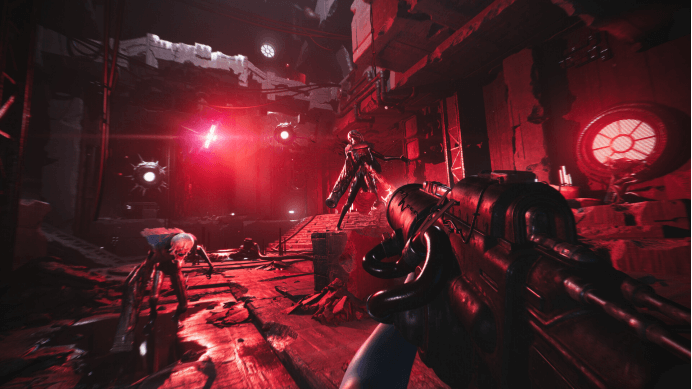
At the end of the game, I didn’t usher in the final judgment or redemption. When I arrived at the core of the deep prison, the cold cavity known as the “Heart of the Moon”, I only found a huge server array that had long stopped running and the wreckage of the final command. The directive shows that the ultimate design purpose of the prison is not to discipline, but to “accommodate” — to accommodate all the unsolvable human contradictions, technical ethics and collective madness after the failure of a colonial experiment. They couldn’t solve it, so they chose to build a tombstone large enough to seal it. My arrival only triggered the automatic mourning mechanism of this tombstone.
After leaving the game for a long time, the feeling of being scrutinized by a huge creation has not dissipated. What _Luna Abyss_ made me experience was not the pleasure of jailbreak, but a kind of almost archaeological sadness. It made me understand that the heaviest shackles are sometimes not tangible, but poured into steel and concrete, and an era of silent confession of its own guilt. And those climbing and listening under the huge shadow finally make us understand that sometimes the only way to understand history is to walk into the cold and endless darkness in person and touch the indescribable but still hot marks on the wall.