

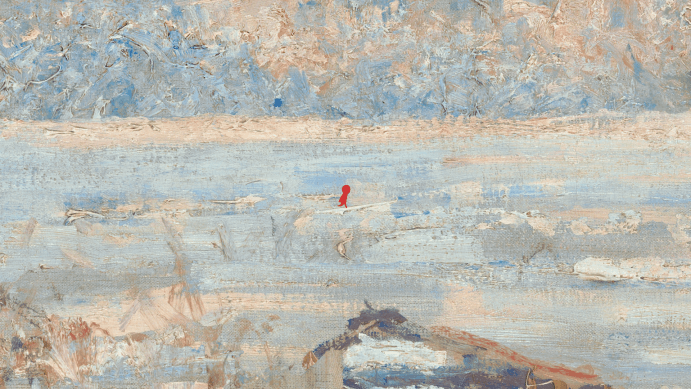
When my world was filled with soft color blocks for the first time, I didn’t know that it was the inside of an eye. The light purple, gray-blue and milky white halos permeate each other at the boundary like watercolor, without any sharp lines, only flowing transitions. I — no name, no form, just a little bright consciousness — floating in this quiet sea of colors, and in the distance, a round light spot is slowly expanding, like the sunrise, and the pupils adapting to the light. _The Master’s Pupil_ told me from the beginning that this was not an adventure, but a slow pilgrimage in the depths of other people’s senses.
Moving is a contemplative push-pull. I need to reconcile the color: adjust the overly warm orange to the blue to balance the temperature, so that the precipitated purple can re-float into the mist, and sometimes even reduce the saturation of the whole area to see the hidden shape. There is no written explanation of the puzzle, only the logic of the color itself — when I adjust a water into an appropriate “morning gray”, the outline of the water lily will appear; when the light is adjusted to the angle of “afternoon tilt”, the reflection of the bridge arch will be complete. There is no punishment for failure, but the world remains in a state of disharmony, as if shaking its head gently: It’s not right, feel it again.
As the journey deepened, I realized that I was reappearing someone’s visual memory. Those color blocks gradually condensed into familiar pictures: the reliefs of Rouen Cathedral emerged in the light and shadow, the outline of the poplar tree swayed in the wind, and when the water of the water lily pond was fully unfolded for the first time, I could almost smell the virtual humid air. The most moving design of the game is that it does not show the complete painting, but only allows me to “grow” every detail by myself by adjusting the color and light. I’m not watching art, but experiencing the moment when art is seen, confused, and finally fixed on the canvas.
However, challenges also follow. The color of some areas began to become cloudy, and the boundaries were difficult to identify, like a layer of lingering tulle. I need to separate the tone more carefully, and sometimes even try dozens of times to regain the clarity that the picture should have. At this time, there will be a faint low and stable humming sound in the background sound, which is not like music, but more like a physiological sound — later I realized that it was a metaphor for vision decline. What I am fighting against is not only the color puzzle, but also the horizon that the painter is gradually blurring.
The chapters of the game are in the name of painting, but the progress is not linear. Sometimes I will suddenly jump back to the early “Garden” from the mature “Haystack”. The style of the picture suddenly changes, the color becomes bolder, and the boundaries become clearer, as if time goes back. This kind of jump allowed me to experience the evolution of the painter’s visual language: from the pursuit of appearance to capturing light and shadow, and finally embracing the almost abstract and pure color impression. Every style change is accompanied by a change in the logic of the puzzle. I need to forget the thinking formula of the previous chapter and relearn to “watch”.
When I approached the end, I reached the deepest part of the pupil. There are almost no concrete shapes here, only rotating and mixed color whirlpools. The last puzzle I want to complete is to arrange all the floating dots into a harmonious whole. There is no reference, no hint, only the inner intuition of “balance”. When I finally made the chaos present a comforting order, all the colors faded gently, leaving only a pure white.
Then, slowly, a line of handwritten font appeared in the white center: “Thank you for reading it for me.”
After quitting the game, I walked to the window. The afternoon sun is dyeing the room into a warm golden color, and the edges of the shadow are blurred and soft. I blinked my eyes and realized so clearly for the first time that the whole world I saw at this moment was just an exquisite and brief color performance projected on the retina after the light passed through the lens of my pupils. _The Master’s Pupil_ didn’t give me knowledge about Monet’s life. It gave me a chance to become someone else’s pupil. It makes me believe that the deepest secret of art may never be on the canvas, and when the painter gazes at the world, the eyes that try to compress infinite light and shadow into limited colors. And each of us is using our own pupils to reconcile the unique and never-repeated tone for the world.